

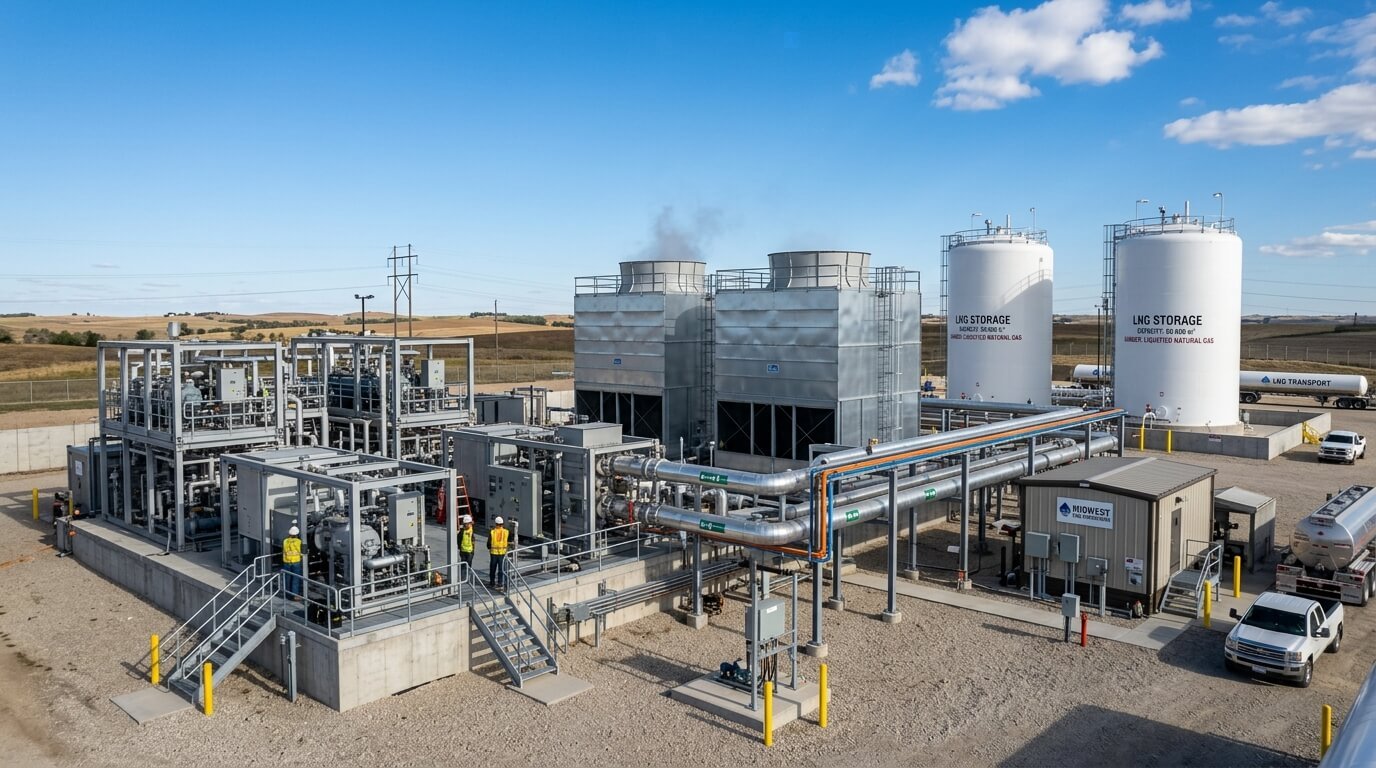

The demand for flexible and efficient LNG solutions is growing, especially in locations where large-scale facilities are not practical or economically viable. Small-scale LNG liquefaction makes it possible to liquefy natural gas, biogas, or biomethane on a smaller scale and make it available locally as LNG or bioLNG. By organizing production closer to the gas source or end user, new opportunities arise for decentralized energy projects. This approach offers a practical way to produce liquefied gas, particularly for industrial applications, regional distribution, LNG as a fuel, and projects involving renewable gas streams.
Why Choose Small-Scale LNG Liquefaction?
Small-scale LNG liquefaction is not just about lower production capacity, but above all about flexibility. A compact, modular plant can be tailored to the available gas flow and the desired LNG production. Skid-mounted systems minimize on-site construction work and enable efficient installation and commissioning. This is particularly advantageous for projects where space, lead time, and scalability are key factors. With available capacities of approximately 5, 8.5, and 12 metric tons of LNG per day, a system can be selected to suit a variety of project sizes.
Small-scale LNG liquefaction with Open Loop or Closed Loop technology
Various cooling concepts are available for small-scale LNG liquefaction. An Open Loop configuration uses liquid nitrogen as a consumable cooling source, while a Closed Loop configuration operates with a closed nitrogen cooling cycle. Which configuration is most suitable depends, among other things, on the available facilities, gas flow, and desired operational approach. This allows for the selection of a suitable technical configuration for natural gas, raw biogas, and upgraded biomethane. More information about these options can be found under modular LNG liquefaction systems.
Compact LNG Production Close to the Gas Source
A key advantage of small-scale LNG liquefaction is that production can take place at or near the location where the gas is available. This is relevant, for example, at biogas plants, where biomethane can be processed into bioLNG. Local production can also be beneficial for industrial sites or regional LNG distribution. A compact facility makes it possible to produce liquefied gas without being directly dependent on the scale and infrastructure of a large LNG terminal. As a result, the facility can better accommodate dispersed or relatively small gas flows.
Various applications for small-scale LNG production
Small-scale LNG liquefaction can be applied across various markets and projects. Examples include the production of bioLNG from biomethane, regional LNG distribution, industrial LNG supply, LNG as a fuel, and peak shaving. Especially when an available gas stream does not require a conventional large-scale liquefaction plant, a smaller facility may be a better fit for the situation. The capacity can be tailored to the project, while additional facilities for storage, loading, and gas treatment can be integrated when the application requires it.
Frequently Asked Questions About Small-Scale LNG Liquefaction
What is small-scale LNG liquefaction? Small-scale LNG liquefaction is the process of cooling natural gas, biogas, or biomethane on a smaller scale to produce liquefied natural gas (LNG), using compact, modular systems instead of large-scale liquefaction plants.
What capacities are available for small-scale LNG liquefaction? Depending on the need, systems are available with a production capacity of approximately 5, 8.5, or 12 metric tons of LNG per day.
What is the difference between open-loop and closed-loop systems in small-scale LNG liquefaction? In an open-loop configuration, liquid nitrogen is used as the cooling medium, while a closed-loop configuration employs a closed nitrogen cooling cycle. The choice depends on the available facilities and the desired operational approach.
A suitable solution for decentralized LNG projects
The strength of small-scale LNG liquefaction lies in the combination of compact technology, modular design, and versatility for various gas streams. For projects involving natural gas, biogas, or biomethane, small-scale liquefaction can be an effective way to produce LNG or bioLNG locally. By taking production capacity, gas composition, cooling concept, storage, and logistics into account from the outset, the system can be tailored to a project’s technical and operational requirements. As a result, small-scale LNG production serves as a practical link between local gas production and the subsequent storage, distribution, or use of LNG.
Curious about which configuration best suits your project? Feel free to contact a specialist for personalized advice on the possibilities of small-scale LNG liquefaction.
