

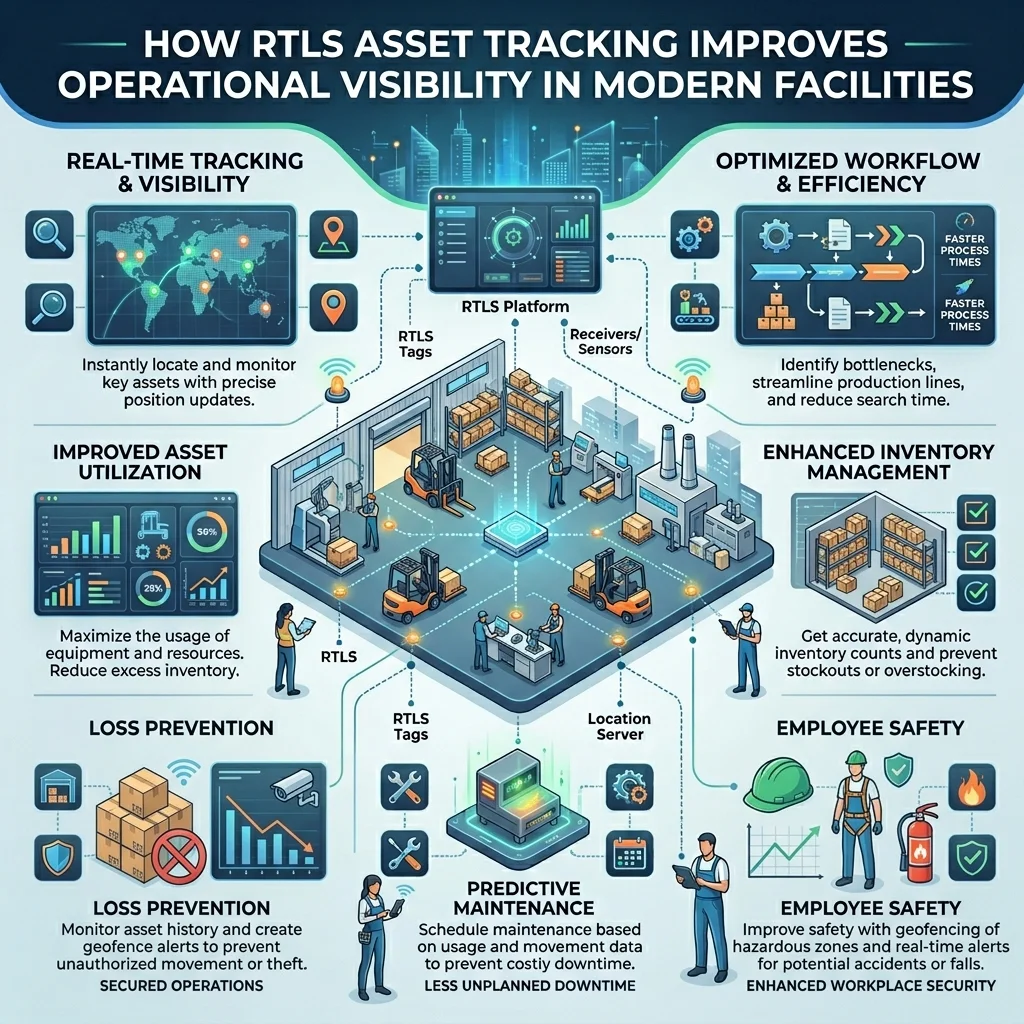

How RTLS Asset Tracking Improves Operational Visibility in Modern Facilities
Walk across the floor of any high-volume manufacturing plant or industrial assembly hub, and you will spot an identical communication gap. Your central enterprise software confidently registers that a critical specialized container, an expensive mold, or a high-value machine component is available and idling in a specific staging area.
Out on the concrete floor, however, an entire line team is burning fifteen minutes of a high-velocity shift tearing the department apart because that asset was moved without a manual database update. This scenario repeats across industries daily, draining productivity, and building intense operational frustration.
Relying on manual clipboard logs, barcode scans, or legacy proximity portals means your management data is constantly lagging into real life. These antiquated processes only capture static historical events. They show you where an item sat hours ago, but they offer zero visibility if an asset gets shifted down the line unexpectedly to keep up with an ad-hoc production change. When managers base scheduling decisions on stale data, operational drift is inevitable.
Deploying RTLS Asset Tracking solves this structural disconnect entirely. By turning your physical production footprint into a continuous spatial data loop, operations teams stop relying on human data entry compliance and start orchestrating tasks based on live floor reality. The entire facility becomes transparent, closing the gap between administrative expectations and shop-floor truth.
Dismantling Ghost Inventory Shortages with Live Updates
When floor teams realize they cannot trust the central database to locate an asset when production lines are moving, they adapt by cheating on the system. Machine operators, maintenance techs, and line lead start building private material reserves. They hide essential testing rigs behind structural pillars, stash unmapped tools under workbenches, or tuck up vital assembly fixtures into personal storage lockers, so they are ready for their next shift.
This survival tactic keeps local stations moving, but it absolutely destroys corporate capital efficiency. When procurement managers view stock reports that show an apparent inventory deficit, they sign off on buying more hardware. You end up spending capital ordering redundant equipment when your real bottleneck is simply an inability to look through your own facility walls.
This artificial scarcity inflates capital expenditures while leaving the root tracking issues unaddressed. Over time, these hidden reserves grow, further cluttering the floor and distorting asset utilization of metrics.
No More Screen Fatigue with Real-Time Tracking and Alerts
Too many operations directors have bought into software packages that promise total oversight but deliver nothing but visual distraction. They install basic tracking systems only to suffer from immediate screen fatigue: a digital map crowded with thousands of identical blinking indicators that give no insight into actual operational urgency. A sea of blue dots moving across a screen does not tell an engineer which line is about to stall due to a missing component.
A practical spatial data network has to connect raw location coordinates to specific business rules to keep the data useful. Knowing where an asset sit is completely meaningless unless your system knows its current certification state and usage history.
- Dynamic Status Mapping: Instantly update an asset workflow profile in your ERP as it enters a physical repair, wash, or inspection bay, eliminating manual tracking steps.
- Proactive Boundary Overrides: Set automated boundary rules that flash warnings or freeze smart equipment operations before an asset passes into an unauthorized area.
- True Utilization Paths: Capture genuine movement histories for material handling vehicles to redesign crowded factory layouts and cut down empty travel loops.
By integrating physical position with asset history, calibration deadlines, and operator clearance, your tracking environment becomes a protective layer. The system monitors the details in the background, stepping in to flag issues before an uncertified, expired, or incorrect tool ever makes contact with an active assembly line. This contextual awareness ensures that visibility serves a purpose, turning raw spatial coordinates into actionable operational insights.
Boost ROI with RTLS and without Closed Architecture Sets
A common obstacle to scaling facility visibility is getting locked into a restrictive hardware ecosystem. An infrastructure provider sells you software that only reads their proprietary active tags, forcing you to deploy high-precision, high-cost tags in zones where general area awareness would be perfectly sufficient. This vendor lock-in drives up total cost of ownership and prevents companies from scaling their systems across different facility types.
Avoiding these budget traps requires a technology-neutral approach to your hardware layer. Your data architecture should be flexible enough to aggregate different signaling protocols based on the physical demands of different rooms. A high-tolerance fabrication cell might require sub-inch Ultra-Wideband (UWB) tracking to clock precise tool orientations, while a raw materials warehouse can run efficiently on standard Wi-Fi or Bluetooth Low Energy (BLE). Combining these varied hardware streams through a unified RTLS framework keeps your initial rollout expenses manageable while giving you the freedom to expand your system as your footprint evolves.
LocaXion Enables Direct Control Over Floor Chaos
LocaXion is the world’s first pure-play RTLS and Digital Twin systems integrator. We engineer systems for your business outcomes, not just tracking.
That means less risk, less integration of guesswork, and faster time-to-value. Because we are not locked to one technology stack, you get the freedom to scale with the right technology, not the technology we happen to sell.
RTLS tracks your assets. LocaXion transforms how your operation runs.
That is the difference. And it is not a small one.
Stop wasting margins on missing equipment and engineer your outcomes today at https://locaxion.com/
