

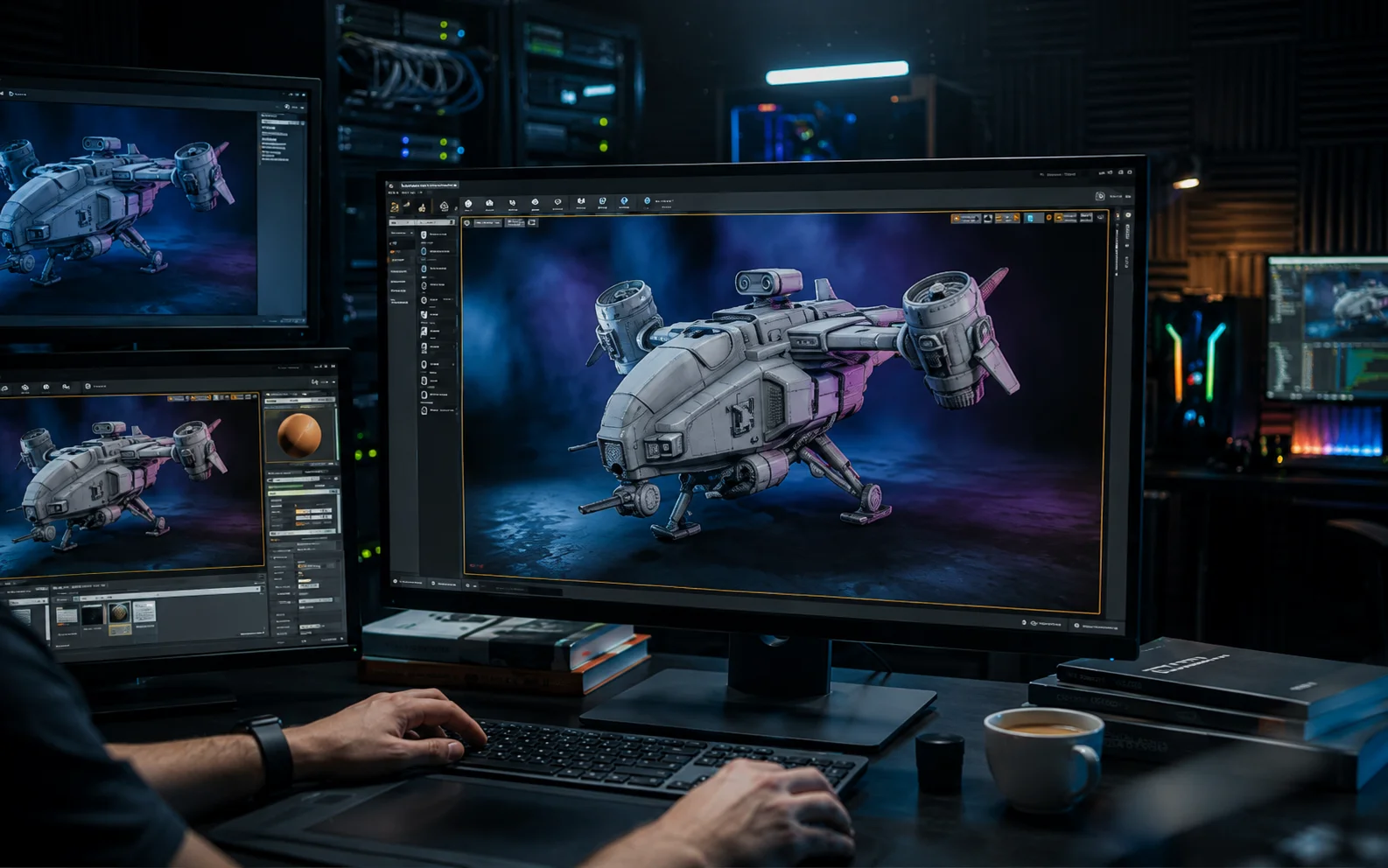

The Next Wave of CGI: AI-Driven 3D Generation in Film Production
Visual effects and CGI production have long struggled with high asset creation costs. Film studios and VFX houses typically spend weeks crafting 3D characters, environment props, and mechanical systems manually. Modeling, retopologizing, and texturing each asset from scratch creates a severe pipeline bottleneck that limits the scale of independent film productions. To address this bottleneck, Neural4D, jointly developed by Nanjing University, DreamTech, Oxford University, and Fudan University, provides a programmatic pipeline for asset generation. By using deep learning networks, the platform moves 3D asset creation from manual sculpting to cloud-based neural rendering.
For creative teams, the initial challenge is converting concept art into structural models. Artists can utilize an online 3D modeling tool to generate basic spatial assets directly from reference images, bypassing the time-consuming block-out phase. Rather than shaping polygons one by one, production artists upload concept drawings to generate structured 3D geometry in minutes. This automation allows VFX departments to build background assets and props rapidly, focusing manual refinement efforts on hero assets and character animations.
Architectural Foundations of VFX Mesh Generation
Traditional photogrammetry tools and generative assets often present unoptimized geometry that causes performance degradation in rendering engines. The Neural4D system relies on a proprietary Direct3D-S2 architecture combined with a Spatial Sparse Attention (SSA) model. This framework achieves a deterministic output that reduces shape irregularities and geometry hallucinations.
By focusing model weights and attention parameters on sparse volumetric boundaries, the system optimizes cloud computing overhead. The performance metrics of this architecture are clearly defined:
- Inference tasks are processed approximately 12 times faster than standard reconstruction pipelines.
- A base mesh, or white model, is generated in about 90 seconds without colors or PBR textures.
- Texture maps and PBR materials are computed in a separate phase, delivering a complete production-ready GLB asset in just over 2 minutes.
Separating spatial geometry from texture mapping is necessary to ensure that lighting details are not baked into the texture channels, preserving dynamic lighting compatibility.
Topology Standards and Relightable Materials
Generative outputs often generate irregular, fragmented meshes known as triangle soup. This geometry requires hours of manual retopology before the meshes are usable in modern VFX pipelines. Neural4D resolves this quality issue by outputting models with clean topology and a logical edge flow. The generated mesh structures are quad-dominant, which simplifies the process of manual modification in standard modeling suites.
The platform also uses a material separation model to isolate diffuse colors from environmental lighting. Many generative tools output models with fixed shadows baked into the maps, making them unusable in scenes with changing light setups. Neural4D generates a pure albedo texture map, which ensures that the asset is fully relightable inside Unreal Engine or Unity. The models are generated as a watertight mesh, eliminating open holes and non-manifold geometry that would cause rendering errors or physical simulation glitches in production.
Interactive Refinement and Pipeline Integration
The utility of programmatic models is extended through interactive workflows. For refinement tasks, the release of Neural4D-2.5 introduces a conversational multimodal interface. Production artists can modify generated meshes using text prompts, instructing the AI to alter specific details, adjust proportions, or swap material properties. This feedback loop allows rapid iterations without requiring constant export-import cycles between tools.
The transition toward automated asset generation is altering how VFX assets are sourced and optimized. By utilizing sparse attention and separating geometry from textures, production teams can bypass traditional modeling bottlenecks and generate engine-ready assets efficiently.
