


The headline figure that most people start with when comparing NHS and private cataract surgery is waiting time. By late 2025, the NHS median wait for cataract surgery in England had grown to over forty-one weeks, against a constitutional standard of eighteen. At some trusts it exceeded a year. Private laser cataract surgery in London, by contrast, is typically available within two to four weeks of a consultation.
That difference matters. But it is not the only difference. Understanding what the additional cost of private laser cataract surgery in London actually pays for helps explain why a growing number of patients are choosing not to wait.
What Femtosecond Laser Adds to Cataract Surgery
Standard NHS cataract surgery uses manual incisions made with a handheld blade and manual capsulorhexis (the circular opening in the lens capsule through which the cataract is removed). These techniques, in the hands of an experienced surgeon, produce very good outcomes. They have done so for decades.
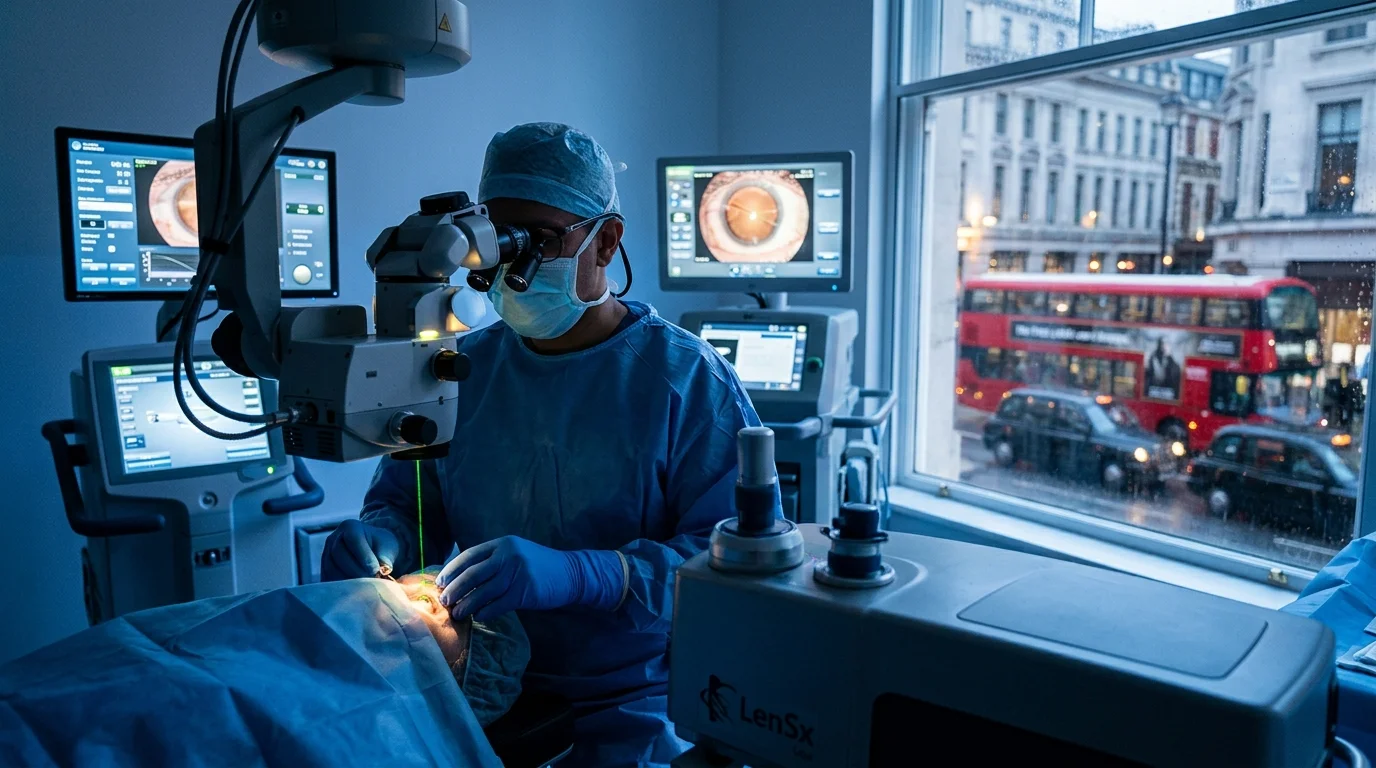
Laser cataract surgery London clinics perform uses a femtosecond laser to create the corneal incisions, the capsulorhexis, and, where needed, precise incisions to reduce pre-existing astigmatism. The laser produces a circular opening in the lens capsule that is measurably more consistent than even highly skilled manual technique. That consistency matters particularly when premium lens implants are being used, because these lenses depend on precise centration to function as intended.
The Lens Implant Question
This is where the two pathways diverge most meaningfully. Standard NHS cataract surgery provides a monofocal lens one that corrects vision at a single distance, typically far. Most patients will still need reading glasses after a standard NHS procedure, and some will also need glasses for intermediate distances.
Laser cataract surgery London private clinics offer includes the option of premium multifocal, trifocal, or extended depth-of-focus (EDOF) lenses. These are designed to provide clear vision across a range of distances far, intermediate, and near reducing or eliminating the need for glasses after surgery. They are not appropriate for every patient, and the consultation process involves a careful assessment of candidacy, including corneal health, pupil dynamics, and lifestyle factors.
For patients who spend significant time reading, working at a screen, or driving particularly at night the choice of lens implant is not a minor detail. It determines the daily visual experience for the rest of their life.
Who Performs the Surgery
NHS cataract surgery is performed by consultant ophthalmologists and, in high-volume hubs, by highly trained specialist nurses operating under consultant supervision. The quality of the surgery is generally very good. What varies is the level of pre-operative planning and the surgeon continuity. The patient who does the consultation is not always the same person who operates.
At a private laser cataract surgery London practice, the consultant who assesses you is typically the same person who performs the procedure and who follows you up afterwards. That continuity allows the surgical plan to be tailored precisely to the individual eye, with adjustments made based on familiarity with the patient’s clinical history and preferences.
The Astigmatism Problem
Approximately thirty per cent of cataract patients have clinically significant pre-existing astigmatism. If this is not addressed at the time of cataract surgery, the patient will need glasses for both distance and near after the procedure which is a worse outcome than someone without astigmatism who has a monofocal lens.
Laser cataract surgery London clinics use toric intraocular lenses and laser arcuate incisions to address astigmatism simultaneously with cataract removal. This is not a standard NHS offering. For a patient with significant astigmatism, the private pathway addresses a problem the standard pathway leaves in place.
Optimal Vision and the London Private Cataract Pathway
Practices such as Optimal Vision offer laser cataract surgery in London with full pre-operative OCT imaging, biometry, corneal topography, and a premium lens consultation that maps out all available options before any decision is made. The aim is to give patients a complete picture of what each choice means for their visual outcome, not simply to process them through a standard protocol.
Final Thoughts
Laser cataract surgery London patients access privately costs more than NHS surgery. What it provides is faster access, femtosecond precision, premium lens options that reduce glasses dependence, astigmatism correction, and surgical continuity. Whether that combination is worth the cost is a personal decision but it is a better-informed decision when the full comparison is understood rather than reduced to a waiting time figure.
