


Introduction
If you’ve ever stood in front of a liquor shelf wondering what makes bourbon different from whiskey, you’re not alone. Many people assume bourbon is simply another word for whiskey. But the truth is a bit more interesting. While every bourbon belongs to the whiskey family, not every whiskey qualifies as bourbon.
Think of it like squares and rectangles. Every square is a rectangle, but not every rectangle is a square. In the same way, bourbon follows very specific rules that set it apart from other types of whiskey.
In this easy-to-follow guide, we’ll explore the difference between bourbon and whiskey, how they are made, their ingredients, flavor profiles, and why they taste so different. By the end, you’ll feel much more confident the next time you’re choosing a drink.
1. What Is Whiskey?

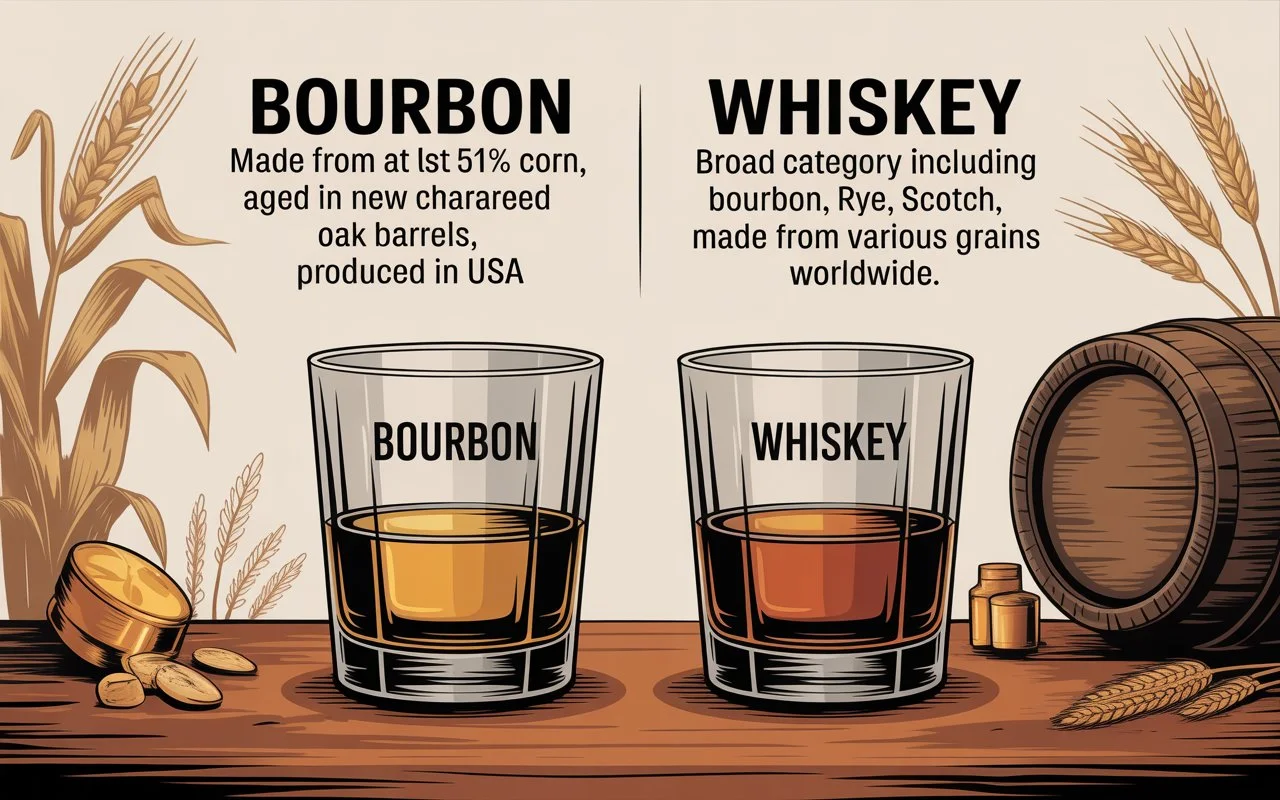
Whiskey is a broad category of distilled alcoholic drinks made from fermented grain mash. The grains used can include barley, corn, rye, or wheat. After fermentation, the liquid is distilled and aged in wooden barrels.
Different countries produce their own styles of whiskey. For example:
-
Scotch from Scotland
-
Irish whiskey from Ireland
-
American whiskey from the United States
-
Canadian whisky from Canada
Each region has its own traditions and rules, which influence the final taste.
In simple terms, whiskey is the umbrella, and many different styles exist under it.
2. What Is Bourbon?
Bourbon is a distinct style of whiskey that originates in the United States and follows specific production standards set by law. To legally be called bourbon, the drink must follow strict rules defined by U.S. law.
These rules include:
-
Made in the United States
-
At least 51% corn in the grain mixture
-
Aged in new charred oak barrels
-
Distilled to no more than 160 proof
-
Entered into barrels at 125 proof or less
Because of the high corn content, bourbon often tastes slightly sweeter and smoother than many other whiskeys.
Interestingly, while many people associate bourbon with Kentucky, it can technically be made anywhere in the United States.
3. Key Ingredient Differences
One of the biggest distinctions between bourbon and other whiskeys lies in the grain recipe, often called the mash bill.
Bourbon Ingredients
Bourbon must contain:
-
Minimum 51% corn
-
Remaining grains may include rye, barley, or wheat
Corn adds natural sweetness, giving bourbon its smooth and rich flavor.
Other Whiskey Ingredients
Other whiskeys use different grain combinations, such as:
-
Scotch: mostly malted barley
-
Rye whiskey: at least 51% rye
-
Irish whiskey: barley and other grains
Because each grain has its own taste, the final drink can vary widely.
4. Where They Are Made
 Location also plays a role in the difference between bourbon and whiskey.
Bourbon
-
Must be produced in the United States
-
Kentucky produces about 95% of the world’s bourbon
Other Whiskeys
Whiskey can be produced worldwide, including:
-
Scotland
-
Ireland
-
Canada
-
Japan
-
India
-
Australia
Each region’s climate and water supply influence the character of the drink.
5. The Distillation Process
The process of making both bourbon and whiskey starts with fermenting grains into alcohol, followed by distillation.
However, there are slight differences in regulations.
Bourbon Distillation
-
Distilled to 160 proof or lower
-
Bourbon is a uniquely American variety of whiskey defined by strict legal guidelines and traditional production methods.
These limits help preserve the natural flavors from the grains.
Other Whiskey Distillation
Some whiskey styles allow higher proof distillation, which can create lighter or more neutral flavors.
6. Aging and Barrel Requirements
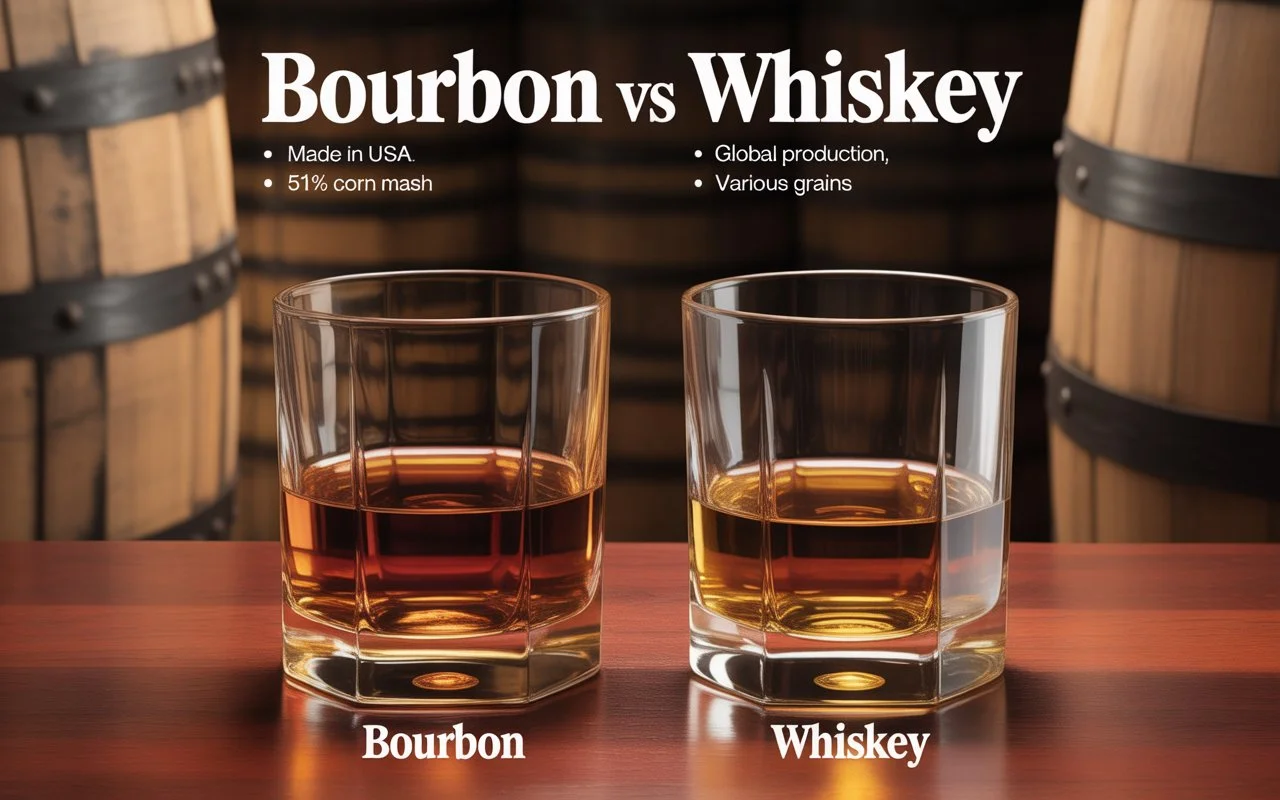
Aging plays a major role in shaping the flavor of bourbon and whiskey.
Bourbon Barrel Rules
Bourbon must be aged in:
-
Brand-new charred oak barrels
These fresh barrels add flavors like:
-
Vanilla
-
Caramel
-
Toasted wood
-
Smoke
Other Whiskey Barrels
Many other whiskeys reuse barrels that previously held:
-
Bourbon
-
Wine
-
Sherry
This recycling creates different flavor profiles.
7. Flavor and Taste Profiles
One of the easiest ways to tell the difference between bourbon and whiskey is by taste.
Typical Bourbon Flavors
Bourbon often features:
-
Caramel
-
Vanilla
-
Honey
-
Toasted oak
-
Brown sugar
The corn base gives it a rounder and sweeter flavor.
Typical Whiskey Flavors
Other types of whiskey may include:
-
Smoke
-
Spice
-
Fruit
-
Malt
-
Earthy notes
For example, Scotch whisky often has peaty, smoky flavors.
8. Color and Appearance
The deep golden color of bourbon and whiskey comes from aging in wood barrels.
Bourbon Color
Thanks to the use of freshly charred oak barrels, bourbon typically develops:
-
Rich golden shades
Other Whiskey Color
Other whiskies may appear lighter depending on:
-
Barrel age
-
Barrel type
-
Climate
Interestingly, bourbon cannot have added coloring, while some other whiskies may use caramel coloring.
9. Popular Types of Whiskey
The whiskey world is huge and diverse.
Some well-known styles include:
Scotch Whisky
-
Made in Scotland
-
Often smoky and complex
Irish Whiskey
-
Usually smoother and lighter
Canadian Whisky
-
Known for its mild and easy-drinking style
Rye Whiskey
-
Spicy and bold flavor
Each style brings something unique to the table.
10. Popular Bourbon Brands
Bourbon has become incredibly popular worldwide.
Some famous brands include:
-
Jim Beam
-
Maker’s Mark
-
Buffalo Trace
-
Woodford Reserve
-
Wild Turkey
These brands vary in taste, age, and price, but all follow bourbon’s strict production rules.
11. How to Drink Bourbon and Whiskey
There’s no single “correct” way to enjoy these drinks. It all depends on personal preference.
Popular Ways to Drink Them
-
Neat: straight without ice
-
On the rocks: served with ice
-
With water: a few drops can open flavors
-
Cocktails: such as Old Fashioned or Manhattan
Bourbon’s sweetness often makes it great for cocktails, while some whiskeys shine when sipped slowly.
12. Price and Availability
Prices vary widely depending on factors like:
-
Age
-
Brand reputation
-
Production size
-
Rarity
Bourbon Prices
Bourbon ranges from affordable everyday bottles to rare collector editions.
Whiskey Prices
Some whiskies—especially aged Scotch—can cost hundreds or even thousands of dollars.
For beginners, there are many excellent options under $40.
13. Which One Is Better for Beginners?
If you’re new to the world of whiskey, bourbon can be a great starting point.
Why?
-
Sweeter flavor
-
Less smoky
-
Often smoother
Many newcomers find bourbon easier to enjoy compared with heavily peated Scotch whisky.
However, everyone’s taste is different. The best approach is simple: try both and see which one you prefer.
14. Common Myths About Bourbon and Whiskey
Let’s clear up a few misunderstandings.
Myth 1: Bourbon must be made in Kentucky
Not true. It can be made anywhere in the United States.
Myth 2: Bourbon must be aged for years
Straight bourbon must be aged at least two years, but regular bourbon has no minimum.
Myth 3: Whiskey always tastes harsh
Good whiskey can actually be smooth, sweet, and complex.
Conclusion
Learning the distinction between bourbon and whiskey is actually quite simple once you break down the basics.Whiskey is the larger category, covering many styles made around the world. Bourbon, on the other hand, is a uniquely American whiskey with strict rules about ingredients, production, and aging.
Because bourbon uses a corn-heavy mash and new charred oak barrels, it often delivers a sweeter, richer taste compared to other whiskeys. Meanwhile, the broader whiskey family offers an incredible variety of flavors—from smoky Scotch to spicy rye.
In the end, choosing between bourbon and whiskey is a bit like choosing between coffee and tea. Both are enjoyable, but each offers its own personality. The best way to discover your favorite? Pour a glass, take a sip, and explore the flavors for yourself.
FAQs
1. Is bourbon stronger than whiskey?
Not necessarily. Both bourbon and other whiskeys usually contain similar alcohol levels, typically around 40–50% ABV.
2. Why is bourbon sweeter than other whiskey?
Bourbon contains at least 51% corn, which naturally adds sweetness and smoothness to the flavor.
3. Can bourbon be made outside the United States?
No. By law, bourbon must be produced in the United States.
4. What is the main difference between bourbon and Scotch whisky?
Bourbon uses mostly corn and new charred oak barrels, while Scotch is typically made from malted barley and often aged in reused barrels.
5. Is bourbon better for cocktails than whiskey?
Many bartenders prefer bourbon for cocktails because its sweet and rich flavor blends well with mixers and bitters.
