


Introduction
Ever been driving smoothly when suddenly your car feels off—like it’s coughing instead of purring? 😬 The check engine light turns on, and now you’re worried. One common reason behind this scenario is the P0300 code. It sounds technical, but don’t worry—you don’t need to be a mechanic to understand it.
Think of your engine like a team of runners passing a baton. If one runner stumbles randomly, the whole relay suffers. That’s exactly what a random engine misfire does. In this guide, we’ll break everything down in plain English so you know what’s going on, why it matters, and what to do next.
What Is the P0300 Code?
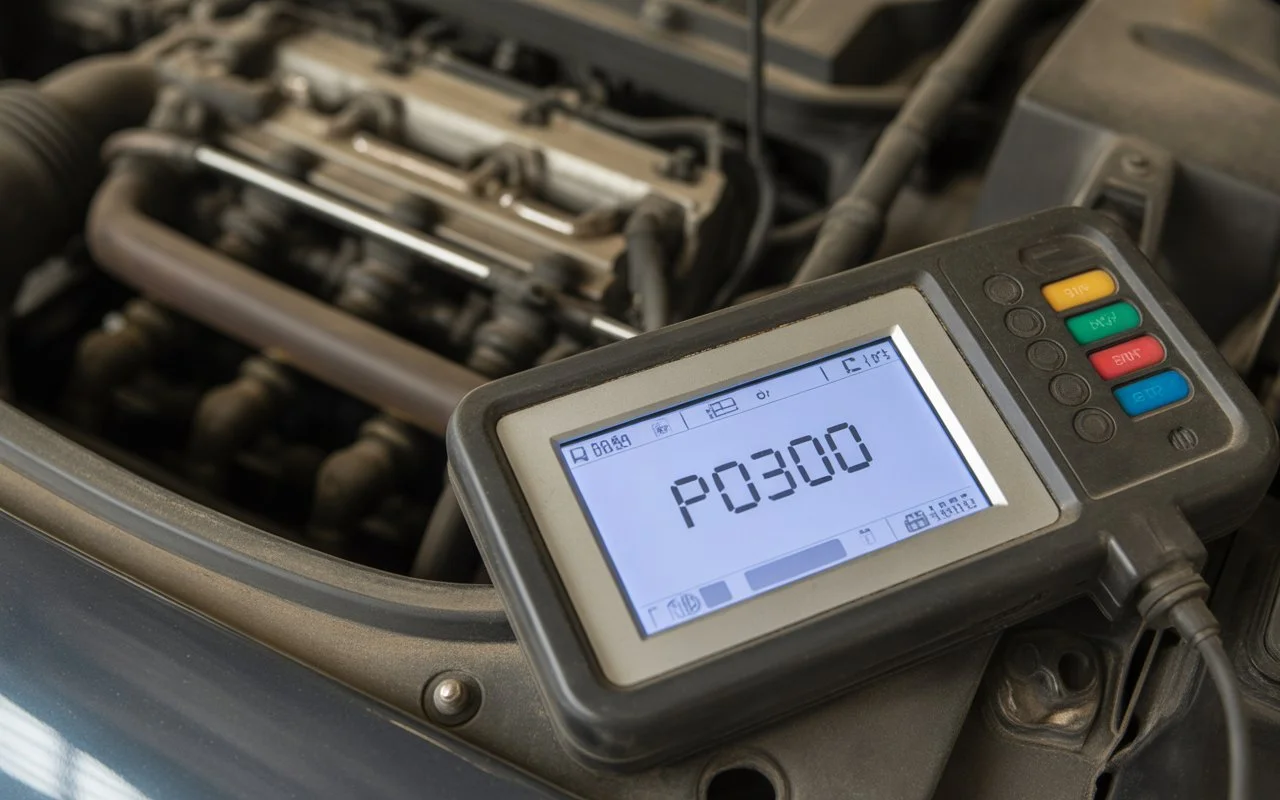
The P0300 code means your car’s engine is experiencing random or multiple cylinder misfires. Unlike codes that point to one specific cylinder, this one tells you the problem is moving around.
In simple terms, your engine isn’t firing smoothly all the time. One moment it’s fine, the next it stumbles. The car’s computer notices this inconsistency and triggers the check engine light.
What Does “Random Misfire” Really Mean?

A misfire happens when fuel inside the engine doesn’t burn properly. When this happens randomly across different cylinders, it’s labeled as P0300.
Imagine popcorn popping in a pan. When every kernel pops evenly, things go smoothly. But if some kernels don’t pop—or pop late—you get uneven results. That uneven burn is what your engine is experiencing.
Common Symptoms You Shouldn’t Ignore
You might notice one or more of these signs:
-
Rough idling (the car shakes at stoplights)
-
Hesitation when accelerating
-
Reduced fuel efficiency
-
Loss of power
-
Check engine light blinking or steady
If your car feels “off,” trust that instinct. It’s usually right.
Why the P0300 Code Happens
The tricky part is that P0300 isn’t caused by one single issue. Instead, it’s often a combination of problems affecting combustion.
Broadly, causes fall into four buckets:
-
Ignition problems
-
Fuel delivery issues
-
Air or vacuum problems
-
Sensor or computer faults
Let’s unpack them one by one.
Spark Plug and Ignition Issues
Your spark plugs are tiny but mighty. When they wear out or get dirty, they can’t ignite fuel properly.
Common ignition-related causes include:
-
Worn or damaged spark plugs
-
Faulty ignition coils
-
Old or cracked plug wires
This is often one of the cheapest and easiest fixes, which is good news.
Fuel System Problems
Your engine needs the right amount of fuel at the right time. Too much or too little fuel leads to misfires.
Fuel-related issues may include:
-
Clogged fuel injectors
-
Weak fuel pump
-
Dirty fuel filter
If fuel flow is inconsistent, misfires can jump from one cylinder to another—triggering the P0300 code.
Air and Vacuum Leaks
 \
\
Engines rely on a precise air-to-fuel mix. When extra air sneaks in, things go out of balance.
Possible air-related causes:
-
Cracked vacuum hoses
-
Leaking intake manifold gasket
-
Dirty or faulty mass airflow sensor
Think of it like trying to sip a drink through a straw with holes—you’re getting air instead of what you need.
Sensor and Computer-Related Causes
Modern cars rely heavily on sensors. If one sends bad information, the engine reacts poorly.
Key sensors involved include:
-
Crankshaft position sensor
-
Camshaft position sensor
-
Oxygen sensors
When sensor data is unreliable, misfires may appear random even though there’s a clear underlying issue.
Is It Safe to Drive With a P0300 Code?
Short answer? Not really.
While you might drive for a short time, ignoring the problem can damage your catalytic converter, which is expensive to replace. If your check engine light is flashing, stop driving as soon as possible.
It’s like limping on a sore ankle—possible, but risky.
How Mechanics Diagnose the P0300 Code
Professional mechanics use diagnostic tools to read live engine data. They look for patterns and test components step by step.
Typical diagnosis may include:
-
Scanning misfire counts
-
Inspecting spark plugs and coils
-
Checking fuel pressure
-
Smoke testing for vacuum leaks
This systematic process helps narrow down what’s actually wrong.
DIY Checks You Can Do at Home
Before heading to the shop, you can do a few simple checks:
-
Look for loose hoses under the hood
-
Inspect spark plugs for wear
-
Check for overdue maintenance
Even basic observations can save time and money.
Repair Costs and What to Expect
Costs depend on the root cause:
-
Spark plugs: low cost
-
Ignition coils: moderate cost
-
Fuel injectors or sensors: higher cost
Early diagnosis often means a cheaper fix—waiting rarely helps.
How to Prevent Future Misfires
Prevention is easier than repair. Stick to regular maintenance like:
-
Timely spark plug replacement
-
Using quality fuel
-
Fixing small issues early
Your engine will thank you with smoother rides and fewer surprises.
When to See a Professional Mechanic
If the problem keeps coming back or your car struggles badly, it’s time to call in a pro. Persistent misfires are a sign something deeper needs attention.
Listening early can save your wallet later.
Conclusion
The P0300 code may sound intimidating, but it’s really your car asking for help. Whether it’s a worn spark plug or a deeper fuel issue, understanding the problem puts you in control.
Think of this code as your engine clearing its throat—it just needs the right care to run smoothly again. 🚗✨
FAQs
1. What does the P0300 code mean?
It indicates random or multiple engine misfires detected by your car’s computer.
2. Can bad fuel cause a P0300 code?
Yes, poor-quality or contaminated fuel can disrupt combustion.
3. Will the P0300 code clear itself?
Sometimes, but if the underlying issue remains, it will usually return.
4. Is a P0300 code expensive to fix?
It depends on the cause—simple fixes are affordable, major issues cost more.
5. Can I drive short distances with a P0300 code?
Short distances may be possible, but it’s not recommended, especially if the light is flashing.
