

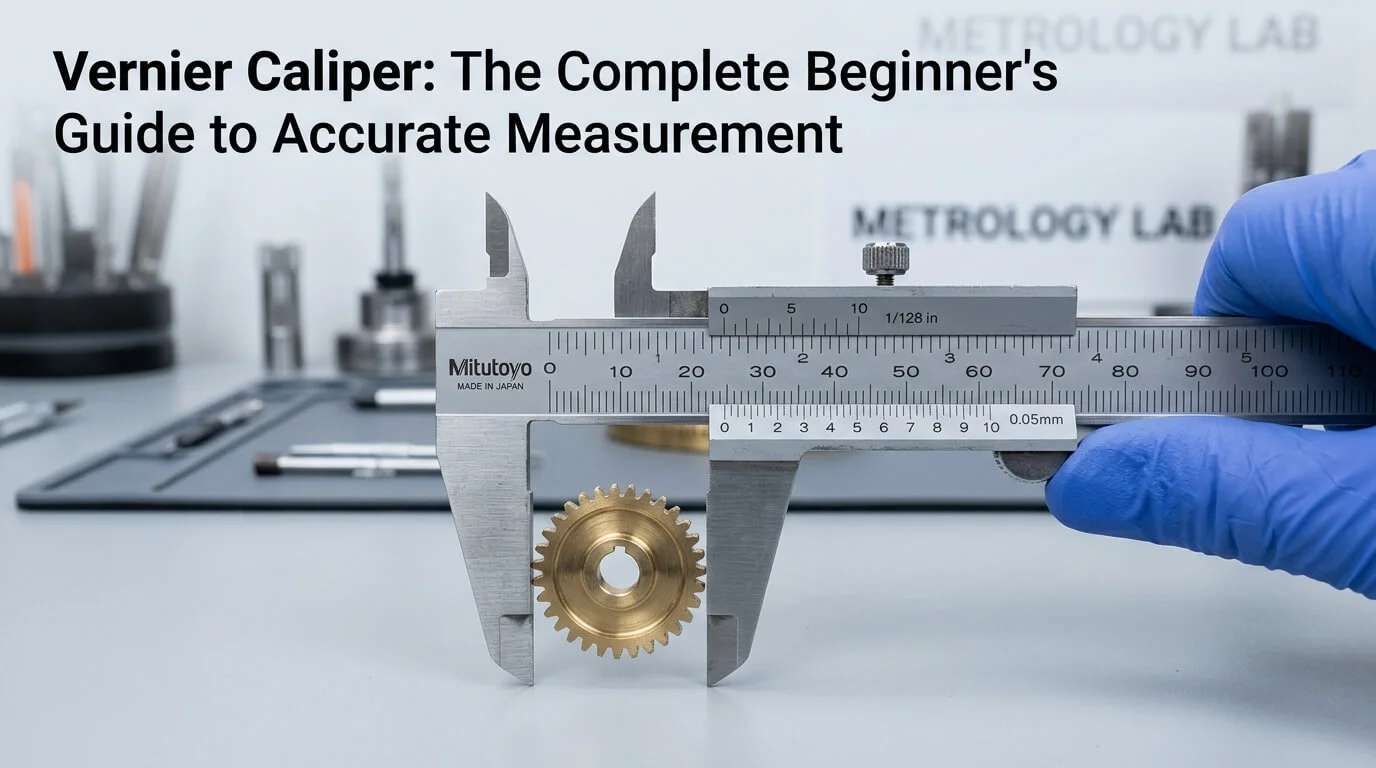

Vernier Caliper: Everything You Need to Know
Have you ever wondered how engineers, mechanics, or students measure tiny objects with incredible accuracy? A normal ruler works well for everyday measurements, but when precision matters, professionals rely on a vernier caliper. This versatile measuring tool can measure the length, diameter, thickness, and depth of an object with remarkable accuracy.
Think of a vernier caliper as a magnifying glass for measurements. Just as a magnifying glass helps you see tiny details, this instrument helps you measure dimensions that are difficult to determine using ordinary scales. Whether you’re a student, hobbyist, technician, or simply curious about measuring tools, understanding how a vernier caliper works is a valuable skill.
1. What Is a Vernier Caliper?
A vernier caliper is a precision measuring instrument used to measure external dimensions, internal dimensions, and depth with high accuracy. Unlike a standard ruler, it provides readings down to fractions of a millimeter or inch.
It is widely used in:
- Mechanical engineering
- Manufacturing
- Woodworking
- Metalworking
- Science laboratories
- Educational institutions
- Automotive workshops
Its ability to provide accurate measurements makes it one of the most trusted measuring instruments in technical fields.

2. History of the Vernier Caliper
The concept of the vernier scale was introduced by Pierre Vernier, a French mathematician, in 1631.
His invention solved a major problem—how to read measurements more precisely than standard scales allowed.
Over the centuries, the design has improved significantly, leading to:
- Stainless steel construction
- Fine adjustment screws
- Digital displays
- Improved durability
- Better measurement accuracy
Even today, the traditional vernier caliper remains popular because it doesn’t require batteries and offers dependable precision.
3. Main Parts of a Vernier Caliper
Understanding each part makes using the tool much easier.
Outside Jaws
These measure the external dimensions of objects, such as width, thickness, or outside diameter.
Inside Jaws
The smaller upper jaws measure the internal diameter of holes or pipes.
Main Scale
This fixed scale shows the primary measurement in millimeters or inches.
Vernier Scale
The sliding scale provides additional precision beyond the main scale.
Depth Rod
Located at the end of the caliper, this rod measures the depth of holes or slots.
Lock Screw
It locks the sliding jaw to preserve the measurement.
Thumb Roller
This allows smooth and controlled movement while measuring.
4. How a Vernier Caliper Works
The instrument combines two scales:
- Main Scale
- Vernier Scale
The main scale provides the whole number measurement, while the vernier scale identifies the decimal portion.
The principle works by comparing small differences between the markings on both scales. When one line on the vernier scale aligns perfectly with the main scale, that alignment determines the precise reading.
This clever design enables measurements much finer than those possible with an ordinary ruler.
5. Types of Vernier Calipers
Several versions are available depending on the application.
Standard Vernier Caliper
Uses engraved scales and requires manual reading.
Best for:
- Schools
- Workshops
- Laboratories
Dial Caliper
Includes a dial indicator for easier reading.
Advantages:
- Faster readings
- Reduced human error
- Easy to interpret
Digital Caliper
Displays measurements on an LCD screen.
Benefits include:
- Instant reading
- Metric/inch conversion
- Higher convenience
- Minimal calculation
Specialized Calipers
Designed for unique industrial applications such as:
- Gear measurement
- Pipe inspection
- Brake disc measurement
6. How to Read a Vernier Caliper
Reading a vernier caliper becomes simple with practice.
Step 1: Clean the Tool
Ensure no dirt affects the measurement.
Step 2: Place the Object
Position the object between the jaws.
Step 3: Close the Jaws
Apply gentle pressure.
Step 4: Read the Main Scale
Record the whole number before the zero mark of the vernier scale.
Step 5: Find the Matching Vernier Line
Locate the line that perfectly aligns with the main scale.
Step 6: Calculate the Reading
Final Reading = Main Scale Reading + Vernier Scale Reading
For example:
- Main Scale = 25 mm
- Vernier Reading = 0.36 mm
Final Measurement = 25.36 mm
7. Common Applications
A vernier caliper has countless practical uses.
Engineering
Used to measure machine components with precision.
Manufacturing
Ensures products meet exact specifications.
Automotive Repair
Measures brake discs, bolts, shafts, and engine parts.
Medical Equipment
Used during manufacturing of surgical instruments.
Jewelry Making
Measures gemstones and precious metals accurately.
Education
Helps students learn precision measurement techniques.
DIY Projects
Useful for woodworking, metal crafting, and home repairs.
8. Advantages and Limitations
Advantages
High Accuracy
Offers measurements more precise than rulers.
Multiple Functions
Measures:
- External dimensions
- Internal dimensions
- Depth
Portable
Compact enough to carry anywhere.
Durable
Stainless steel versions last for many years.
No Electricity Required
Traditional models work without batteries.
Limitations
- Requires practice to read correctly.
- Incorrect alignment may produce errors.
- Digital versions require battery replacement.
- Not suitable for extremely microscopic measurements.
9. Common Mistakes to Avoid
Many beginners make avoidable mistakes.
Measuring with Dirty Jaws
Dust affects precision.
Applying Too Much Force
Excess pressure changes measurements.
Ignoring Zero Error
Always check whether the caliper reads zero before use.
Reading the Wrong Scale
Metric and inch scales can be confusing.
Holding the Tool at an Angle
Keep it straight for reliable results.
10. Care and Maintenance
Proper maintenance extends the life of the tool.
Clean After Every Use
Wipe away dust and grease.
Store Properly
Keep it inside a protective case.
Avoid Moisture
Prevent rust by storing in a dry place.
Lubricate Occasionally
Light oil keeps the sliding movement smooth.
Check Calibration
Regular calibration maintains measurement accuracy.
11. Vernier Caliper vs Other Measuring Tools
| Tool | Accuracy | Best Use |
|---|---|---|
| Ruler | Low | Simple length measurement |
| Measuring Tape | Medium | Long distances |
| Vernier Caliper | High | Precision measurement |
| Micrometer | Very High | Extremely small dimensions |
A ruler may tell you an object is about 25 mm wide, while a vernier caliper can reveal it is exactly 25.42 mm.
12. Tips for Accurate Measurements
To achieve the best results:
- Keep the tool clean
- Practice reading the scale
- Use gentle pressure
- Measure twice
- Check for zero error
- Avoid dropping the instrument
- Calibrate periodically
- Use the correct jaws
- Store safely after use
- Handle with care
Small habits like these significantly improve accuracy and prolong the tool’s lifespan.
Conclusion
A vernier caliper is one of the most valuable precision measuring tools available. From classrooms to engineering workshops, it delivers dependable accuracy for measuring external dimensions, internal diameters, and depths. Although it may seem intimidating at first, anyone can learn to use it with a little practice.
Whether you’re building a machine, repairing a vehicle, creating jewelry, or completing a science experiment, this instrument provides confidence in every measurement. By understanding its parts, learning the reading process, avoiding common mistakes, and maintaining it properly, you’ll get accurate results for years to come.
Frequently Asked Questions (FAQs)
1. What is a vernier caliper used for?
A vernier caliper is used to measure the external size, internal diameter, thickness, and depth of objects with high precision.
2. What is the least count of a vernier caliper?
The least count varies by model, but common values are 0.02 mm, 0.05 mm, or 0.1 mm.
3. Which is more accurate, a ruler or a vernier caliper?
A vernier caliper is far more accurate than a ruler because it measures small fractions of a millimeter or inch.
4. Can beginners learn to use a vernier caliper easily?
Yes. With a little practice and by following the proper reading steps, beginners can quickly become comfortable using the instrument.
5. How should I maintain a vernier caliper?
Clean it after use, store it in a protective case, keep it dry, lubricate moving parts occasionally, and check its calibration regularly.
