

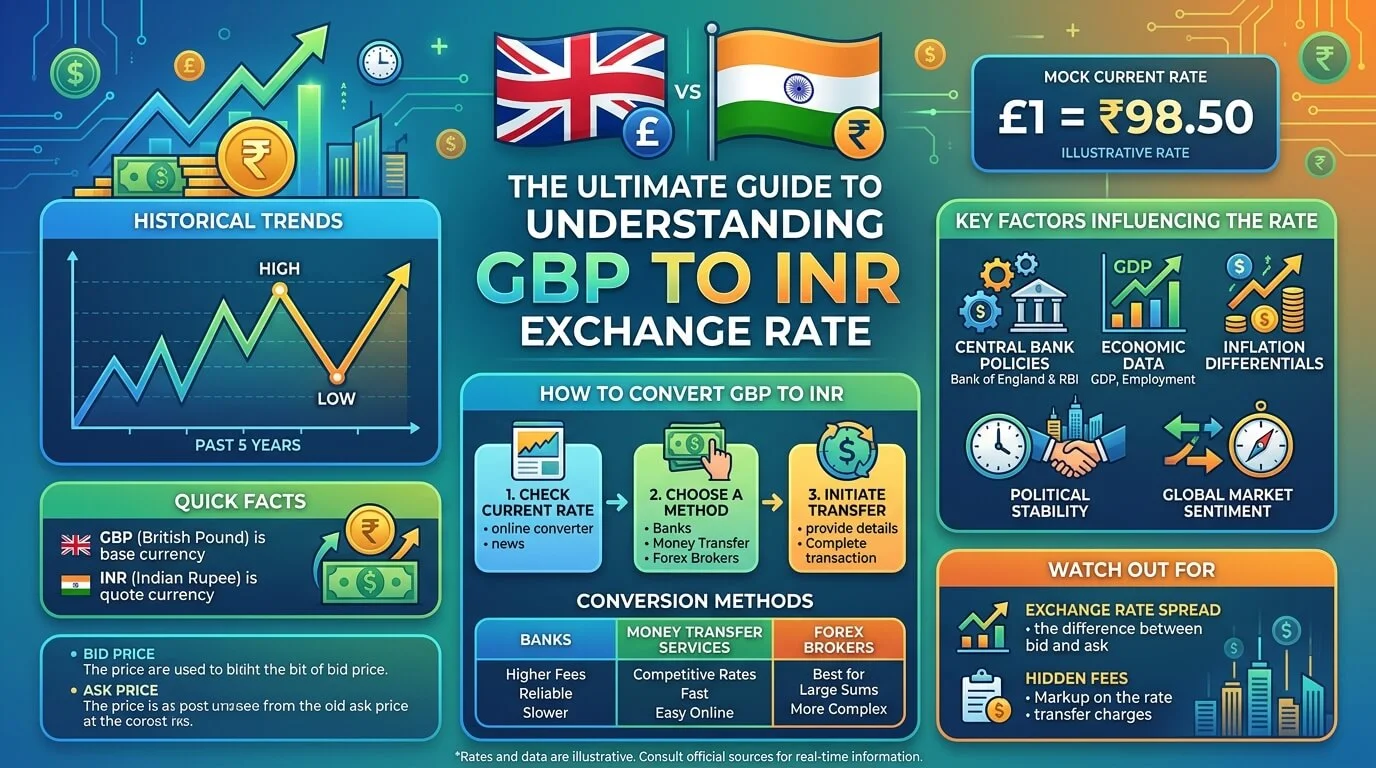

GBP to INR Exchange Rate: Everything You Need to Know
Whether you’re planning a trip to India, sending money to family, studying abroad, investing internationally, or simply keeping an eye on global currencies, understanding the GBP to INR exchange rate is incredibly useful. Currency values change every day, sometimes every minute, making exchange rates an important part of international finance.
Think of the exchange rate as a bridge connecting two different economies. Just as a bridge allows people to travel between two places, the exchange rate allows money to move between countries. Knowing how this bridge works helps you make better financial decisions and avoid unnecessary costs.
In this comprehensive guide, we’ll explain everything you need to know about converting British Pounds (GBP) into Indian Rupees (INR), the factors influencing exchange rates, historical trends, and practical tips for getting the best value.
1. What Does GBP to INR Mean?
GBP to INR refers to the exchange rate between the British Pound Sterling (GBP) and the Indian Rupee (INR).
For example:
- If 1 GBP = ₹120, one British Pound can be exchanged for 120 Indian Rupees.
- If the rate changes to ₹118, the Pound has weakened against the Rupee.
- If it rises to ₹122, the Pound has strengthened.
Exchange rates fluctuate continuously due to global financial markets.
2. Understanding the British Pound
The British Pound Sterling (GBP) is the official currency of the United Kingdom.
Key Facts
- Currency Code: GBP
- Symbol: £
- Issued by the Bank of England
- One of the world’s oldest currencies
- Considered one of the strongest reserve currencies globally
The Pound plays an important role in international trade, investment, and foreign exchange markets.

3. Understanding the Indian Rupee
The Indian Rupee (INR) is India’s official currency.
Key Facts
- Currency Code: INR
- Symbol: ₹
- Issued by the Reserve Bank of India (RBI)
- Used by over one billion people
- One of Asia’s most actively traded currencies
India’s growing economy has made the Rupee increasingly significant in global markets.
4. How Exchange Rates Work
Exchange rates represent the value of one currency compared to another.
Floating Exchange Rates
Most major currencies, including GBP and INR, operate under a floating exchange rate system. Their values are determined by market demand and supply.
Example
Imagine thousands of buyers and sellers trading Pounds and Rupees every second. If more people want Pounds, its value rises. If demand falls, its value declines.
This constant trading causes exchange rates to change throughout the day.
5. Factors That Affect GBP to INR
Several economic and political factors influence currency values.
Interest Rates
Higher interest rates often strengthen a country’s currency because investors seek better returns.
Inflation
Countries with lower inflation generally experience stronger currencies over time.
Economic Growth
Strong GDP growth boosts investor confidence and can increase currency value.
Political Stability
Stable governments attract international investment.
Trade Balance
Countries exporting more than they import often experience stronger currencies.
Global Events
Examples include:
- Financial crises
- Pandemics
- Wars
- Elections
- Commodity price changes
These events can significantly impact exchange rates.
6. Historical Trends of GBP to INR
The GBP to INR exchange rate has changed dramatically over the decades.
Past Performance
Historically:
- The Pound has usually remained stronger than the Rupee.
- India’s economic reforms influenced currency movements.
- Brexit created major fluctuations.
- Global inflation also affected exchange rates.
Understanding historical trends helps people make informed financial decisions, although past performance does not guarantee future results.
7. Why the Exchange Rate Changes Daily
Many people wonder why today’s exchange rate differs from yesterday’s.
The answer lies in the global foreign exchange market, which operates almost 24 hours a day.
Daily movements occur because of:
- Economic reports
- Central bank announcements
- Investor confidence
- Market speculation
- International trade
Even small pieces of news can influence billions of dollars in currency trading.
8. How to Convert GBP to INR
Currency conversion is straightforward.
Simple Formula
Indian Rupees = British Pounds × Exchange Rate
Example
If:
- 100 GBP
- Exchange Rate = ₹120
Then:
100 × 120 = ₹12,000
Many online currency converters perform this calculation instantly.
9. Best Ways to Exchange Money
Several methods are available.
Banks
Reliable and secure but may charge higher fees.
Pros
- Safe
- Trusted
- Transparent
Cons
- Processing fees
- Less competitive exchange rates
Money Exchange Companies
Often provide better rates than traditional banks.
Always compare multiple providers before exchanging large amounts.
International Money Transfer Services
These are popular for sending money overseas.
Advantages include:
- Fast transfers
- Competitive rates
- Online convenience
Airport Exchange Counters
These are convenient but usually offer the least favorable exchange rates.
If possible, exchange only a small amount at airports.
10. Tips to Get Better Exchange Rates
Everyone wants more value when converting currencies.
Here are practical tips:
Compare Rates
Never accept the first offer.
Monitor Market Trends
Watch exchange rate movements for a few days before converting.
Avoid Airport Exchanges
Airport counters often charge higher margins.
Use Online Comparison Tools
Many websites compare rates from multiple providers.
Exchange Larger Amounts
Some providers offer better rates for larger transactions.
Check Hidden Fees
A great exchange rate may be offset by service charges.
Always calculate the final amount you’ll receive.
11. Common Mistakes to Avoid
People often lose money because of avoidable errors.
Ignoring Service Fees
Low rates sometimes hide expensive transaction costs.
Not Comparing Providers
Different companies may offer significantly different rates.
Waiting Too Long
Trying to predict the perfect exchange rate can backfire.
Exchanging at Tourist Locations
Hotels and tourist areas often offer poor rates.
Not Checking Live Rates
Exchange rates change frequently.
Always verify the latest rate before making a transaction.
12. Future Outlook for GBP to INR
Predicting currency movements with complete accuracy is impossible.
However, several factors will likely influence future trends:
- UK economic growth
- Indian economic performance
- Inflation levels
- Central bank policies
- Global trade
- International political developments
Financial experts generally recommend focusing on long-term planning rather than trying to predict short-term currency movements.
Why GBP to INR Matters
The exchange rate impacts many aspects of daily life.
Students
Tuition fees become more or less expensive.
Travelers
Holiday budgets change depending on exchange rates.
Businesses
Import and export costs fluctuate.
Investors
International investment returns can increase or decrease.
Families
People sending money abroad receive different amounts depending on market conditions.
Understanding exchange rates helps everyone make smarter financial decisions.
How Technology Has Improved Currency Exchange
Modern technology has transformed international money transfers.
Today’s users can:
- Compare rates instantly
- Track live exchange rates
- Send money online
- Receive exchange alerts
- Complete secure international payments within minutes
These innovations have made currency conversion faster, safer, and more transparent than ever before.
Conclusion
Understanding the GBP to INR exchange rate doesn’t have to be complicated. Whether you’re traveling, studying, investing, or sending money internationally, knowing how exchange rates work can save you both time and money.
While exchange rates constantly fluctuate due to economic conditions, inflation, interest rates, and global events, staying informed helps you make better financial choices. Compare providers, monitor market trends, avoid unnecessary fees, and exchange currency strategically rather than impulsively.
Like watching the weather before planning a picnic, checking exchange rates before converting your money can make a significant difference. A little preparation today can lead to better financial outcomes tomorrow.
Frequently Asked Questions (FAQs)
1. What does GBP to INR mean?
GBP to INR is the exchange rate that shows how many Indian Rupees one British Pound is worth.
2. Why does the GBP to INR exchange rate change every day?
It changes because of supply and demand, interest rates, inflation, economic news, political events, and global financial market activity.
3. Where can I get the best GBP to INR exchange rate?
Comparing banks, licensed currency exchange providers, and reputable international money transfer services usually helps you find the most competitive rate.
4. Is it better to exchange money before traveling to India?
In many cases, yes. Planning ahead gives you more time to compare rates and avoid expensive airport exchange counters.
5. Can I predict future GBP to INR exchange rates?
No one can predict exchange rates with certainty. However, monitoring economic trends and market conditions can help you make more informed decisions.
