

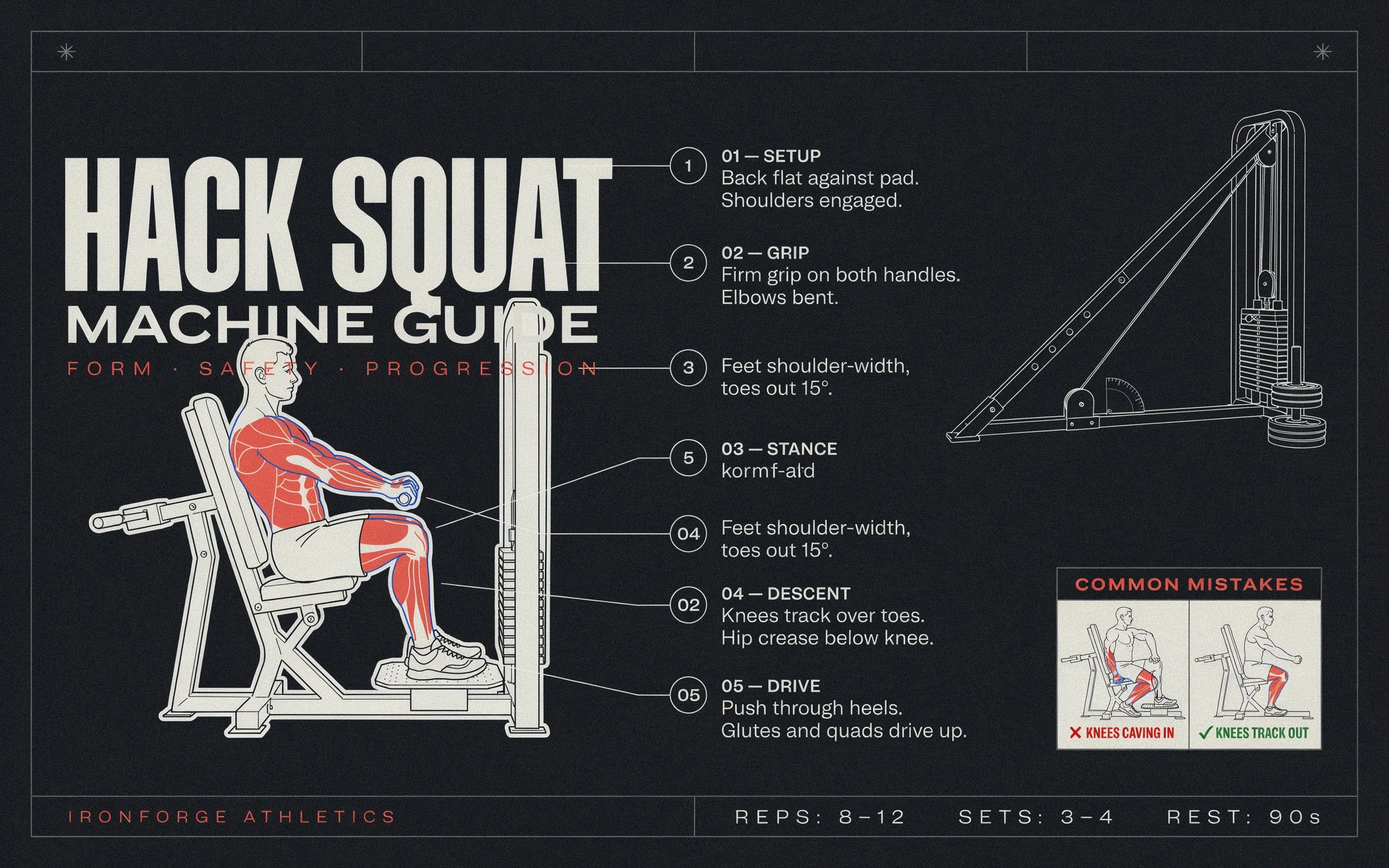

Hack Squat Machine
“Hack Squat Machine “If you’ve ever walked into a gym and spotted a big angled machine loaded with plates, there’s a good chance you were looking at a hack squat machine. It can seem a little intimidating at first. You step in, place your shoulders under pads, put your feet on a platform, and then lower yourself into a squat while the machine guides your path. Sounds simple enough, right? In many ways, it is—but there’s more to it than just pushing weight up and down.
The hack squat machine has become a favorite for people who want to build stronger legs, challenge their lower body, and squat with more support than a traditional barbell squat offers. Whether you’re new to leg day, coming back after a break, or just curious about adding a new movement to your routine, this guide will walk you through everything you need to know in plain English.
Think of the hack squat machine as training wheels for some parts of the squat—but not in a bad way. It still demands effort, control, and focus, yet it helps stabilize your body so you can put more attention on driving through your legs. That makes it useful for beginners and experienced gym-goers alike.
Below, we’ll cover how the machine works, what muscles it targets, the right way to use it, common mistakes, safety tips, workout ideas, and how it compares to other squat options.

1. What Is a Hack Squat Machine?
A hack squat machine is a lower-body gym machine designed to mimic a squat pattern while providing guided movement. Instead of holding a barbell on your back, you stand on a platform and position your shoulders under padded supports. The machine moves along a fixed track as you bend your knees and hips to lower your body, then push back up.
The result is a squat-like movement with extra support and balance. Because the path is guided, you don’t have to worry as much about keeping a bar stable on your back or balancing your body in open space. That doesn’t mean it’s easy—it just means the challenge is focused more directly on your legs.
Hack squat machines vary slightly by brand. Some are plate-loaded, where you add weight plates to the sides. Others are selectorized, meaning you choose the weight with a pin. Most commercial gyms use the plate-loaded version.
2. How the Hack Squat Machine Works
The machine places your body at an angle, usually somewhere around 45 degrees. Your back stays against a pad while your shoulders sit under the shoulder supports. Your feet rest on a large platform in front of you.
When you unlock the machine, you lower yourself by bending your knees and hips. The sled moves down the rails. Then you drive through your feet to return to the starting position.
Why the guided path matters
The fixed track changes the feel of the squat in a few key ways:
- More stability: You don’t need to balance a barbell.
- More lower-body focus: Less energy is spent on staying upright.
- Easier to learn for some people: The movement pattern is simpler to practice.
- Can feel safer for lifters training alone: Most machines have safety handles or stops.
This setup often lets people train their quads hard without worrying as much about the technical demands of a free-weight squat.
3. Muscles Worked During Hack Squats
The hack squat machine is mainly a lower-body strength exercise, and it targets several major muscle groups.
Primary muscles worked
Quadriceps
These are the muscles on the front of your thighs, and they do a huge amount of work during hack squats. In fact, many people use the machine specifically to emphasize their quads.
Glutes
Your glutes help extend the hips as you push back up from the bottom of the squat. They play an important role, especially if you squat deep.
Secondary muscles involved
Hamstrings
While the hack squat is not primarily a hamstring exercise, the hamstrings still assist with hip control and overall lower-body movement.
Calves
Your calves help stabilize your ankles and contribute to pushing through the platform.
Core
Your core works to keep your torso braced against the pad and maintain control, though the demand is lower than in a barbell squat.
In short, the hack squat machine is a leg-dominant exercise with a strong emphasis on the quads and glutes.
4. Main Benefits of Using a Hack Squat Machine
Why do people like the hack squat machine so much? Because it can be a powerful tool for building lower-body strength and muscle while reducing some of the balancing demands of free-weight squats.
1. Great for quad development
If your goal is to grow your thighs or strengthen the front of your legs, the hack squat machine can be extremely effective. The setup naturally keeps tension on the quads, especially when your feet are placed lower on the platform.
2. More support than barbell squats
Some people struggle with bar positioning, upper-body mobility, or balance in regular squats. The hack squat machine removes several of those obstacles, allowing you to focus on the leg drive itself.
3. Easier to train close to failure
Because the machine supports your movement, many lifters feel more comfortable pushing hard on this exercise. It can be easier to perform challenging sets without worrying about dumping a barbell or losing balance.
4. Helpful for learning squat mechanics
While it doesn’t replace free-weight squats completely, it can help beginners understand how it feels to bend the knees, sit into a squat, and push through the legs.
5. Good for muscle-building workouts
The machine works well in moderate to higher rep ranges, making it a popular choice for hypertrophy-focused training.
5. Who Should Use a Hack Squat Machine?
One of the best things about this machine is that it can fit many training styles and experience levels.
Beginners
If you’re new to strength training, the hack squat machine can be a more approachable way to learn a squat pattern. You still need good form, but you don’t have to manage a barbell at the same time.
Intermediate and advanced lifters
More experienced lifters often use hack squats to overload the quads, add extra leg volume, or train hard after barbell squats.
People who want more leg work with less balance demand
If your balance, shoulder mobility, or upper-body strength limits your regular squat, the machine can help you keep training your legs effectively.
Bodybuilders and physique-focused trainees
Because it allows targeted leg work and controlled reps, it’s a staple in many muscle-building programs.
That said, not everyone will love it. Some people find the angle awkward, and others with knee, hip, or lower-back issues may need to modify or avoid it depending on how it feels.
6. How to Use a Hack Squat Machine Correctly
Form matters. A lot. Even though the machine guides your movement, you can still put stress in the wrong places if you rush through the setup.
Step-by-step setup
Step 1: Adjust your body position
Place your back firmly against the back pad and tuck your shoulders under the shoulder pads. Stand tall and grip the handles if the machine has them.
Step 2: Set your feet on the platform
Start with your feet about shoulder-width apart. Toes can point slightly outward. Make sure your whole foot is planted, especially your heels.
Step 3: Unlock the machine
Most hack squat machines have side handles that you rotate or move to unlock the sled. Keep your body tight before releasing it.
Step 4: Lower with control
Bend your knees and hips together as you descend. Keep your back against the pad and let your knees track in line with your toes. Lower until your thighs are at least close to parallel, or as deep as you can go comfortably with good form.
Step 5: Push back up
Drive through your midfoot and heels to return to the top. Think about pushing the platform away rather than lifting with your back.
Step 6: Don’t lock out aggressively
At the top, keep a slight softness in your knees rather than snapping them hard into lockout.
7. Best Foot Placements and What They Change
Small changes in foot placement can change how the movement feels. This doesn’t mean one style is “right” and another is “wrong,” but different setups can shift emphasis.
Feet shoulder-width, mid-platform
This is a solid default starting position. It usually gives a balanced feel between quads and glutes.
Feet lower on the platform
This often increases knee bend and can make the exercise feel more quad-focused. However, it may also put more stress on the knees if your mobility or setup is off.
Feet higher on the platform
A higher foot placement may shift a bit more emphasis toward the glutes and reduce how much the knees travel forward.
Wider stance
A wider stance can feel more comfortable for some people and may bring the inner thighs and glutes more into the movement.
Narrower stance
A narrower stance often increases quad demand, but only if it feels natural and doesn’t force your knees into a bad path.
The best foot placement is the one that lets you squat deeply, keep your feet flat, and feel your legs doing the work without pain.
8. Common Hack Squat Mistakes to Avoid
Even good exercises can become frustrating if form breaks down. Here are some of the most common errors.
Letting your heels lift
If your heels come off the platform, your balance and force production can suffer. It may also push more stress onto the knees and toes. Keep your feet planted.
Going too heavy too soon
This machine can trick people into loading up too much weight because it feels stable. But if your range of motion gets tiny and your knees cave in, the weight is too much.
Cutting the range of motion short
Half reps might inflate your ego, but they don’t always give your muscles the full challenge. Use a depth you can control safely.
Rounding or shifting away from the pad
Your back should stay supported by the pad. If you peel away from it, you lose stability and may create unnecessary strain.
Locking the knees hard at the top
Finish the rep, but don’t slam into your joints.
Allowing the knees to cave inward
Try to keep your knees tracking over your toes. A little movement is normal, but repeated collapse inward is a sign to reduce the load or reset your stance.
9. Hack Squat Machine vs Barbell Squat
This is a common question: if the hack squat machine is so good, do you still need barbell squats?
The answer depends on your goals.
Barbell squats are better for full-body coordination
A barbell squat challenges your legs, core, upper back, balance, and body awareness all at once. It’s a more complete athletic movement.
Hack squats are better for focused leg training
Because the machine supports your torso and balance, you can often direct more attention toward your quads and glutes. It’s more isolated than a barbell squat, even though it’s still a compound exercise.
Barbell squats require more skill
You need to learn bar placement, bracing, balance, depth, and technique under load. That’s not a bad thing—but it does mean there’s a steeper learning curve.
Hack squats can be friendlier for some gym-goers
If you’re not comfortable with a barbell, the hack squat machine may help you train hard while feeling more secure.
The smartest approach for many people is not choosing one forever—it’s using the one that best matches the goal of the workout.
10. Hack Squat Machine vs Leg Press
Hack squats and leg presses are cousins in the gym world. Both are machine-based lower-body exercises, but they feel different.
Hack squat machine
- More upright body position
- Feels closer to a squat
- Usually requires more knee bend
- Strong quad focus
- Can demand more mobility and control
Leg press
- Seated or reclined position
- Often allows very heavy loading
- Lower back is supported
- Can be easier for some people to tolerate
- Foot placement changes feel quite a bit
If the hack squat is like climbing a hill with your legs under you, the leg press is more like pushing a heavy door while sitting back. Both build strength, but the sensation is different.
11. How to Add Hack Squats to Your Workout Routine
Where should this exercise go in your workout? That depends on your training goal.
For beginners
Use it early in your leg workout after a light warm-up, when you still have energy to focus on form.
Example beginner leg day:
- Bodyweight squats or warm-up sets
- Hack squat machine – 3 sets of 8–12 reps
- Romanian deadlift – 3 sets of 8–10 reps
- Walking lunges – 2 sets each leg
- Calf raises – 3 sets of 12–15 reps
For muscle growth
Place hack squats as one of your main quad-focused lifts. Aim for controlled reps and a deep stretch at the bottom.
Example hypertrophy setup:
- Hack squat machine – 4 sets of 8–12 reps
- Leg extension – 3 sets of 12–15 reps
- Bulgarian split squat – 3 sets of 8–10 reps
- Hamstring curl – 3 sets of 10–12 reps
For strength-focused lower-body training
You can use hack squats after barbell squats as a secondary movement.
12. Progression Tips for Strength and Muscle Growth
To get results, you need to do more than just show up and move the sled around. You need progressive overload, which is a fancy way of saying: give your muscles a reason to adapt.
Ways to progress
Add a little weight
Increase the load gradually while keeping form clean.
Do more reps with the same weight
If you did 8 reps last week, aim for 9 or 10 this week.
Improve your range of motion
Better depth with the same control is a form of progress too.
Slow down the lowering phase
A 2–3 second descent can make the exercise much more challenging without adding weight.
Reduce rest slightly for endurance-focused sessions
This works best when your goal is muscular endurance rather than max strength.
Track your sets, reps, and how the movement feels. A notebook or phone app works fine.
13. Hack Squat Variations to Try
Once you’ve mastered the standard version, you can experiment carefully with a few variations.
Paused hack squats
Pause for 1–2 seconds at the bottom before pushing up. This removes momentum and makes the exercise harder.
Slow eccentric hack squats
Take 3–4 seconds to lower down. This increases time under tension and can help you feel the muscles working more clearly.
High-rep hack squats
Use lighter weight and aim for 12–20 reps. These can create a serious leg burn and work well in muscle-focused sessions.
Single-leg assisted hack squat
Some advanced lifters use a one-leg emphasis variation, but this requires caution and control. It’s not the first place to start.
14. Safety Tips and When to Be Careful
The hack squat machine can be a great tool, but no exercise is one-size-fits-all.
Warm up first
Don’t jump straight into heavy sets. Start with bodyweight squats, leg swings, or a few lighter machine sets.
Use a manageable range of motion
You don’t need to force yourself into a painful depth just because someone online said “ass to grass” is the only way. Go as deep as you can while staying controlled and pain-free.
Respect knee or back discomfort
A little muscle burn is normal. Sharp pain is not. If your knees, hips, or lower back hurt in a concerning way, stop and reassess your form—or choose another movement.
Set the safety handles properly
If your machine has safeties, know how they work before you load up the sled.
Don’t bounce out of the bottom
That quick rebound might feel powerful, but it can also put unnecessary stress on your joints.
15. Final Thoughts on the Hack Squat Machine
The hack squat machine is one of the most effective lower-body tools in the gym when used well. It can help beginners learn a squat pattern, give intermediate lifters a reliable way to push their quads hard, and offer advanced trainees a serious muscle-building movement without the same balance demands as barbell squats.
It’s not magic, and it’s not automatically safer just because it’s a machine. Good form, sensible loading, and controlled reps still matter. But if you want an exercise that blends support with challenge—like having guardrails on a steep staircase—the hack squat machine deserves a place on your radar.
Whether your goal is stronger legs, better quad development, more confidence on leg day, or simply adding variety to your workouts, this machine can deliver. Start light, learn the movement, adjust your foot placement, and focus on quality reps. Over time, those small efforts add up to stronger, more capable legs.
FAQs About the Hack Squat Machine
1. Is the hack squat machine good for beginners?
Yes, it can be a great option for beginners because it provides a guided path and more stability than a barbell squat. That said, beginners should still start with light weight and learn proper form.
2. What muscles does the hack squat machine work the most?
The machine mainly targets the quadriceps and glutes. It also involves the hamstrings, calves, and core to a lesser extent.
3. Is a hack squat machine better than a barbell squat?
Not necessarily better—just different. Barbell squats train more full-body coordination and stability, while hack squats are often better for focused leg work and quad emphasis.
4. How low should I go on a hack squat machine?
Go as low as you can while keeping your feet flat, your back against the pad, and your movement pain-free. For many people, that means thighs near parallel or slightly deeper.
5. Can hack squats hurt your knees?
They can if your form is poor, the load is too heavy, or your setup doesn’t suit your body. But when done correctly with a controlled range of motion, many people use them without issues. If you have existing knee pain, it’s wise to be cautious and get guidance if needed.
