

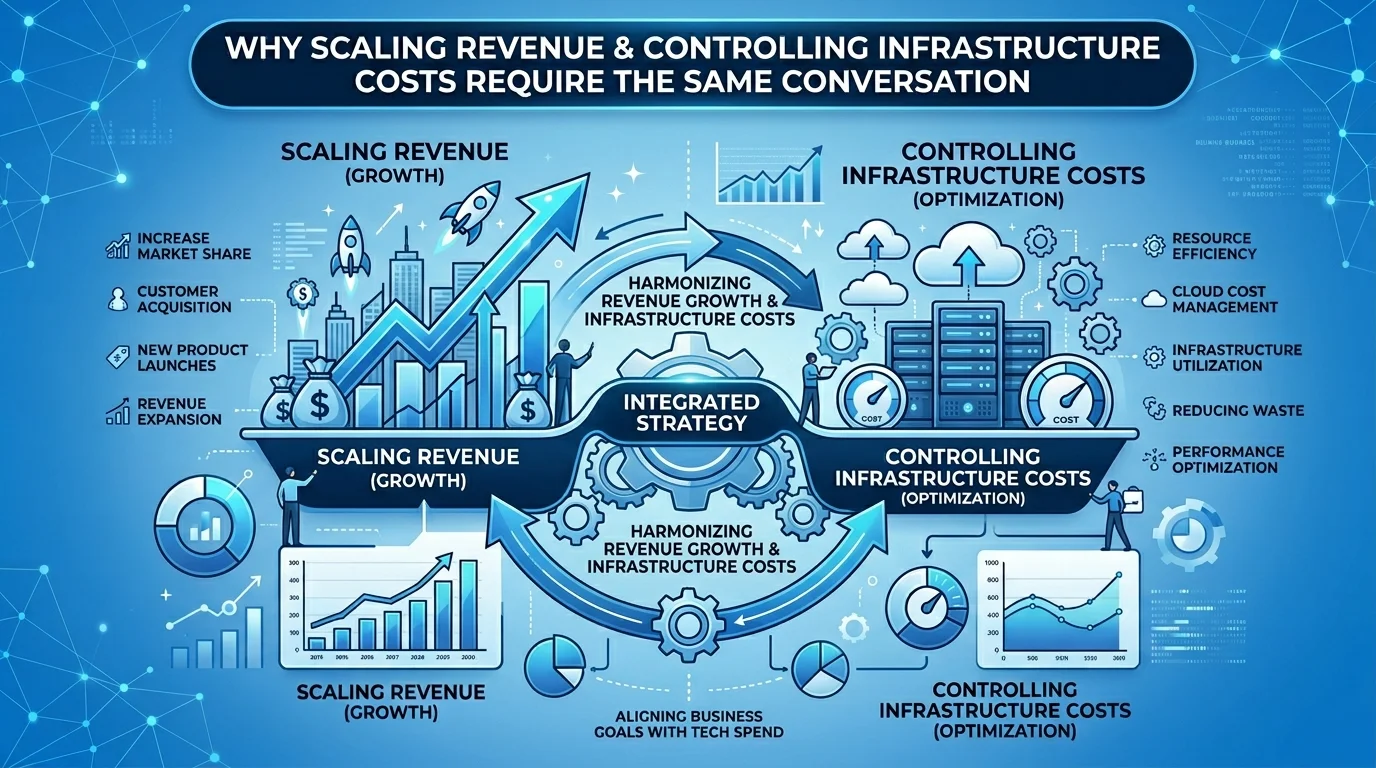

Why Scaling Revenue and Controlling Infrastructure Costs Require the Same Conversation
SaaS companies tend to treat revenue growth and infrastructure costs as problems owned by different teams. Sales and finance worry about revenue. Engineering worries about infrastructure. The two conversations happen in separate rooms, and the gap between them is where margin quietly disappears.
The companies that manage this well don’t have a secret. They just stopped treating cost architecture as an engineering concern and started treating it as a business one.
The Scaling Tax Nobody Budgets For
There’s a pattern that shows up consistently in fast-growing SaaS companies. Revenue doubles. Infrastructure costs triple. Nobody planned for the ratio to invert, but it does, because the original architecture was built for a different scale and nobody stopped to redesign it before the load changed.
Compute costs are the obvious line item, but they’re rarely the whole story. Egress fees accumulate faster than most teams expect. Logging and monitoring costs scale with traffic in ways that aren’t always intuitive. Third-party API dependencies get more expensive as usage grows, sometimes dramatically, because the pricing tiers that looked reasonable at 10,000 requests per month look very different at 10 million.
The teams that manage this best tend to do one thing early: they tag every resource by product feature, customer tier, or revenue-generating function. Not for accounting purposes. Because you can’t make intelligent tradeoffs about where to spend on infrastructure if you don’t know what each piece of infrastructure is actually producing.
When Redundancy Becomes a Revenue Argument
Most SaaS companies treat disaster recovery in the cloud as a compliance requirement or a risk management checkbox. The smarter framing is as a revenue protection decision.
Downtime during peak usage hours for a B2B SaaS product doesn’t just create support tickets. It creates churn conversations. Enterprise customers with SLA requirements will hold you to them, and the cost of a missed SLA can exceed the cost of the redundancy investment many times over. The math usually favors building it correctly the first time rather than negotiating credits after the fact.
That said, not all parts of a SaaS application carry equal business risk. A real-time customer-facing dashboard and a nightly data export job do not need the same recovery architecture. Treating everything as mission-critical inflates costs without improving outcomes. The practical move is to map recovery time objectives to actual business impact, tier your redundancy accordingly, and spend the savings on the parts that genuinely matter.
Revenue Operations Has an Infrastructure Problem It Doesn’t Know About
RevOps teams increasingly rely on data pipelines, CRM integrations, and automated workflows that have real infrastructure dependencies. When those systems are slow, RevOps processes slow down. When they break, forecast accuracy suffers, deal tracking falls behind, and the reporting that leadership depends on becomes unreliable.
This is infrastructure cost and architecture affecting revenue operations directly, not abstractly. A poorly designed data pipeline that reruns transformations unnecessarily is both expensive and slow. Fixing it is an engineering task, but the business case for fixing it belongs to revenue operations.
Getting these two functions to share a vocabulary around cost and performance is harder than it sounds, but it’s more valuable than most optimization initiatives that target either group independently.
Monetization Models Shape Infrastructure Demands
Thinking carefully about how to choose an API monetization model is, among other things, an infrastructure planning exercise. Usage-based pricing creates unpredictable load patterns that flat subscription models don’t. Tiered pricing with generous upper limits can produce a small number of customers who consume a disproportionate share of compute resources.
This isn’t an argument against usage-based or tiered models. Many SaaS businesses are right to adopt them. It’s an argument for understanding the infrastructure implications before the pricing page goes live, not after the first enterprise customer starts hitting limits you didn’t anticipate.
The pricing structure a SaaS company chooses will shape its cost model for years. Building that pricing model without input from engineering is a mistake that tends to surface slowly and expensively.
The Visibility Problem Underneath All of This
Most SaaS companies don’t have a spending problem as much as a visibility problem. The costs are there. The data to understand them is usually available. What’s missing is a shared practice of reviewing infrastructure spend in the context of revenue performance, regularly and with the right people in the room.
When those conversations happen consistently, the tradeoffs become clearer. Some infrastructure investments are worth making because they protect or generate revenue. Others are waste that accumulated because nobody was watching. The difference between the two is almost always visible in the data. It just requires someone to look.
